ZIKZAK Architects

2025-06-11

Infantilism in Commercial Interior Design: Play or Escape?

Infantilism in Commercial Interior Design: Play or Escape?

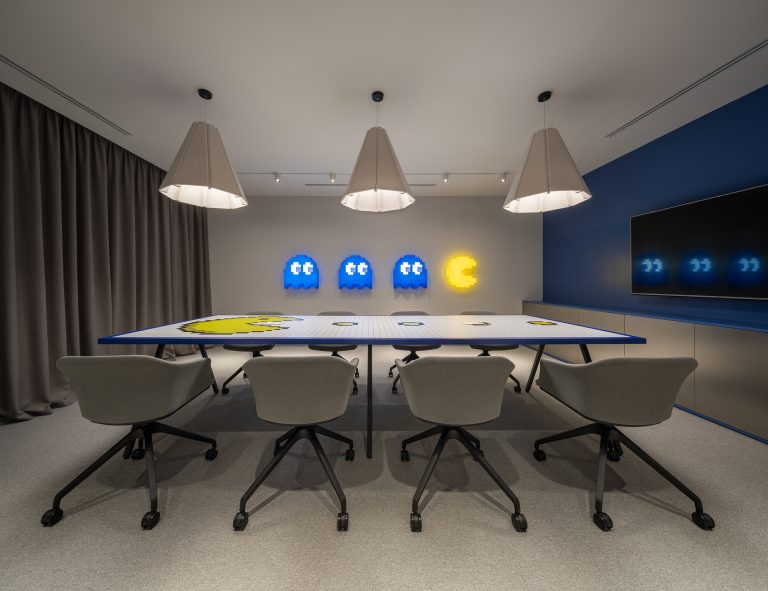
Together with psychologist Vera Romanova, we explore why the aesthetics of infantilism are becoming such an important element in contemporary design. Soft furniture, pastel colors, cute characters, neon lights, swings, and slogans like “Well done!” are increasingly appearing not in playrooms, but in cafes, salons, offices, and even medical clinics. Like basketballs and packmen in our new office project.

This is the aesthetics of infantilism: a visual style that appeals to the inner child. It evokes nostalgia, a sense of safety, and allows us to “let go” a little. After years of strict minimalism, complex fonts, and cold materials, the world is now gravitating towards something softer, warmer, and slightly humorous. Infantilism in design is both an aesthetic and an emotion. These visual and spatial solutions create a feeling of carefreeness, lightness, playfulness, and naivety.

Alessia Karnaukova, CEO of ZIKZAK Architects

In psychology, infantilism is a form of emotional protection, a way to relieve tension, an attempt to regain a sense of control. An unconventional environment reduces the mental filter, fostering idea generation. But it’s not just creativity—it also reduces stress and anxiety. Visual elements from childhood (soft textures, “toy-like” shapes) create a sense of safety and familiarity. This is particularly useful in teams with high tension, where space serves as an emotional container. Such interiors act as spatial antidepressants.

Vera Romanova, PhD in Psychology, Business Consultant

Why does this work? Let me explain using the example of a photo booth in the office.

A photo booth creates a socially safe space for permitted regression—a temporary return to a carefree, playful state, similar to childhood. In therapy, this is sometimes used as a resource intervention—joy without the pressure of responsibility. In the photo booth, you can be anything—it temporarily frees you from the need to be a serious adult. It’s a theatrical, but controlled play. You’re an actor, but for a tiny stage. The person feels they have the right to play, but within clearly defined boundaries: entry – grimace – snap – laughter. This gives freedom without shame because there is a ritual, a scenario, and automaticity (no fear of doing something wrong).

This is a typical soft bonding practice—like team games or team-building, but more natural, informal, and without pressure. In the photo booth, a person is not an object of judgment—they are not a specialist, not a manager, not a newcomer, but just a person. The camera creates a mirrored “self,” in which one can see themselves as someone different—spontaneous, alive. This reduces the anxiety of self-presentation, which is often high in office environments.

Vera Romanova

The photo booth in the office is a therapeutic mini-practice that combines play, spontaneity, emotional release, and symbolic restoration of humanity in a context that often requires masks and roles. It works not against the seriousness of employees, but because of it — providing a space where one can be imperfect without consequences.

Where does it work?

Infantilistic aesthetics are most appropriate in spaces where people are: tired (offices, coworking spaces); anxious (clinics, dental offices); in need of support (beauty studios, psychological centers); looking for easy socialization (cafes, showrooms).
In such interiors, the design’s task is to create an emotional “safe space.” Not just beautiful, but understandable, warm, and free of tension.

Alessia Karnaukova

The space breaks conventions, enhances cognitive flexibility, and promotes creative thinking. People are less likely to fall into clichéd solutions in an environment that challenges expectations. This is critically important for startups, creative teams, and R&D. Infantilistic space deconstructs hierarchy: if the manager sits on a pouf or near a wall-mounted slide — it signals “I’m just a person too.” Or when managers or colleagues laugh together in the photo booth, it reduces distance, creates moments of humanity, and strengthens emotional bonds through shared “playfulness.”

Vera Romanova

Where doesn’t it work?

The environment shapes thinking. Infantilizing space strengthens infantilistic behavior patterns: avoidance of responsibility, shifting focus, excessive creativity without implementation. Therefore, in places where there is no structure in management, employees will start masking problems and playing games with the company.

An example of “how not to do it” — when bright, youthful design is used to mask weak business models, making clients feel part of a “perpetual startup party.”

Infantilism works when:

  • There is a balance between childish and adult elements (flexibility ≠ chaos);
  • The design doesn’t mask an exhausting corporate culture;
  • Employees are not forced to play but are given the choice.

Vera Romanova

From a psychodynamic perspective, regression is not always negative. It is a protective mechanism that: allows you to reboot; temporarily reduces control and helps choose new strategies. In measured doses, it is a path to internal renewal. Spaces with playful or emotionally warm elements create an environment of support. Play is not just entertainment; it is social glue. Shared use of infantilistic environments (table football, cushions, LEGO zones) activates the childlike part of the personality, making it easier to connect and trust others.

We see infantilism as a tool, not a style. It’s not a trend to chase, but a language to understand. Because it’s about: emotional intelligence of space; empathy for the user; and the balance between seriousness and accessibility.

Interior design is always a conversation. Sometimes it’s serious, sometimes it’s gentle, soft, and a bit ironic. We thoughtfully incorporate such complex elements, and in the end, they work towards a positive result.

Alessia Karnaukova